Factoring Overview
Last updated: October 27, 2026
In this article, you will learn
- An overview of Denim's factoring
- An example of how factoring works
- A few common questions about factoring
____________________________________________________________________________
About Denim's Factoring
Denim’s factoring is the most flexible and comprehensive in the business when it comes to customizable carrier payments, invoicing, and collections. Customers only pay for the capital they are using at any given time, which is as close as you can get to a line of credit without going to a bank.
Denim's platform gives you the flexibility to choose between Factored and Non-Factored jobs, enable Express Factoring and offers comprehensive reporting of invoices and payments for your customers and contractors.
____________________________________________________________________________
An example of how factoring works
When you onboard with Denim, you can set up the pricing and the terms for each job that you create in your Denim account.
Please see below for a sample breakdown of job pricing:
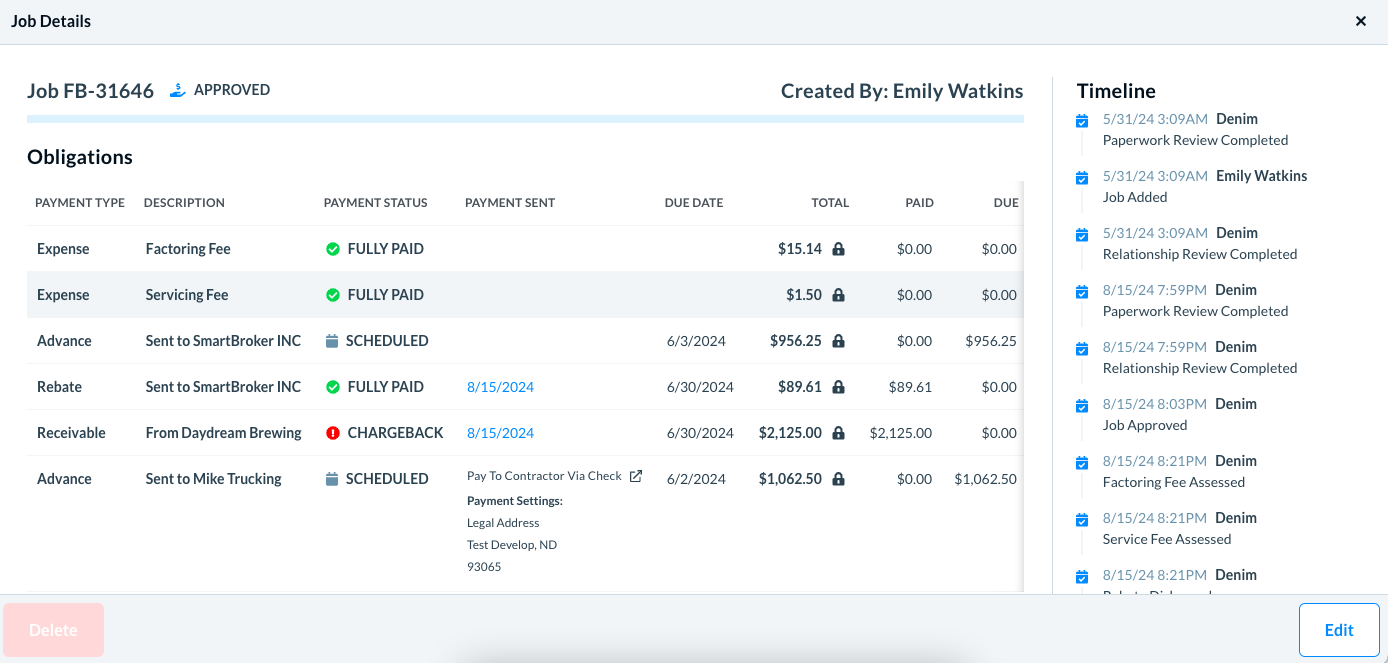
Receivable: This is the amount billed to your customer, in this case $1000.
Advance: This is the percentage of the receivable that Denim pays up front. It is typically 90% of the receivable. There are two components to the advance.
- Carrier pay: Denim will pay the amount billed to you by your carrier. - Let's say your carrier invoice for a job is $950 (95%). In this case, we would pay your carrier the entire amount even though your typical advance is only 90%. This is to ensure a positive experience for your carriers and that they're paid in one lump sum.
- Client advance: Let's say your carrier invoice for a job is $850 (85%). In this case, we would pay your carrier in full, but there would be a 5% remainder from your advance. As the client, you are entitled to this difference, which in this case would be $50.
Rebate: This amount is equal to the receivable minus the advance minus the fee. It is paid to you via Denim Cash, once your customer pays Denim in full for the job. See Denim Cash for more details.
Factoring Fee: This is the percentage that you have agreed to pay for financing each invoice. It is collected at the time your customer pays to Denim. The factoring fee is only charged for factored invoices. For non-factored invoices, other charges may apply, but you will not pay a factor fee.
Servicing Fee: This is the flat per-job fee that you agreed to pay for Denim's non-financing services, including invoicing, collections and support.
__________________________
Example job details view
Here is another example.
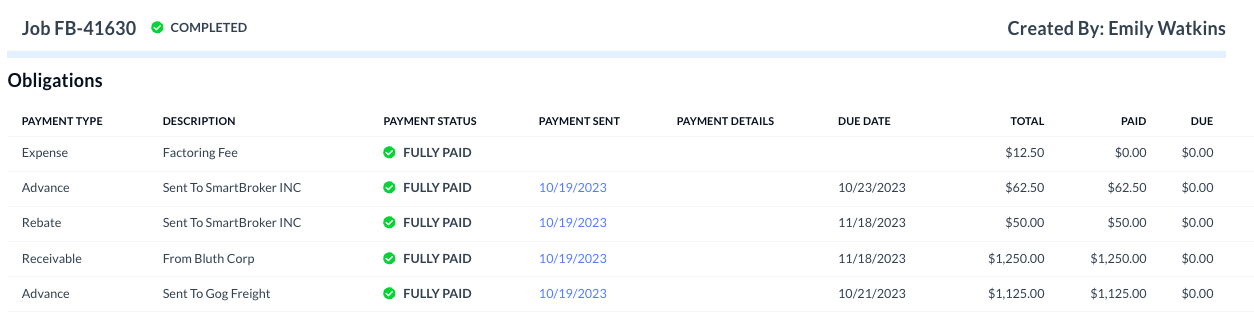
(Please see See and manage job details for more information.)
💡 Note: Although the fee is charged at the time of collection, the fee amount for an individual job is determined at approval. If the billing amount ever changes, please note the factor fee cannot be changed for that approved job; it is locked in when the job is approved. It is therefore important that you bill the correct amount on your first submission. This job-level rule does not by itself confirm that your account-level pricing setup is correct. If a charge appears inconsistent with your agreed account rate, contact support or your CRM contact to review the account pricing and affected loads; a correction or refund may be appropriate if the review confirms an error.
____________________________________________________________________________
Common Questions on Factoring with DSO Pricing
Q: How is my factoring fee calculated?
A: Denim breaks down your factoring fee into a daily rate, and then applies that rate by the customer’s net terms. This calculation is linear, which means that your daily rate stays the same even after their net terms are reached. DSO pricing is not necessarily used for every account; contact support or your CRM contact to verify the pricing method and exact rate for your account.
Q: How do I see my projected factoring fee?
A: The projected factoring fee and the rebates are based on the customers' net terms. For account-specific pricing, contact support or your CRM contact.
Q: Can load size or factoring volume change my account pricing?
A: Account pricing can depend on the size of your loads and how much you factor. Higher factoring volume or different load sizes may affect a future rate review, but there is no general formula, guaranteed reduction, or timeline for calculating a rate from load count alone. Contact support or your CRM contact for your current or future account-specific rate.
Q: Does my signed agreement use a monthly pricing schedule?
A: Some signed factoring agreements set the monthly fee using a schedule that considers both monthly gross factored volume and average monthly invoice value. This applies only when the schedule is included in your signed agreement. Consult your current agreement and ask support or your CRM contact to interpret the applicable criteria. Do not infer an account rate from an automated notice or a complaint alone.
Q: How should I interpret an automated volume-based rate notice?
A: If the notice explicitly states that performance or factoring volume in a prior period qualified you for a lower rate in a stated upcoming period, it is communicating that stated pricing change—not reporting a load-status problem. Use only the prior period, upcoming period, and old and new percentages printed in the notice. The notice alone does not show that a load was funded, delayed, or otherwise affected. Contact support or your CRM contact if you need help interpreting an account-specific notice.
Q: What is the difference between recourse and non-recourse factoring?
A: Recourse generally may have a lower factoring rate because the credit risk of broker nonpayment shifts back to your company. Non-recourse provides added protection when a broker fails to pay for credit-related reasons. The rate difference, available options, fees, and coverage depend on your account; contact support or your CRM contact to review them before making a change.
Q: How do I know when the fee is finalized?
A: Once the customer pays their invoice, the factoring fee and the rebate are finalized based on the number of days the invoice was open. The amount is automatically updated on that job's details page; a lock icon there shows that the amount is finalized. (Please see Contractor: Payment Settings, and Global Settings: Payments to Contractor for more details.)
Q: Why can invoice percentages differ when the invoice and customer-payment dates match?
A: The displayed percentage may be the total factoring fee divided by the full invoice amount. Fees can depend on the dollars advanced and how long each advance remained outstanding, not only on the invoice and customer-payment dates. When an advance is split between an earlier carrier payment and a later client advance, compare the separate amounts and timing: dollars funded earlier remain outstanding longer, and a larger share paid earlier to the carrier can produce a higher blended percentage than dollars advanced later to the client. If the account uses DSO pricing, an adjustment based on how many days past due the debtor paid may also affect the fee; DSO pricing is not used for every account and does not explain a difference when the relevant DSO adjustment is similar. There is no universal formula for calculating an account-specific fee. Contact support or your CRM contact to verify the invoice and account pricing.
Q: Why might the final amount paid to a carrier be lower than expected?
A: When it is confirmed for that transaction, a factoring-fee deduction can account for a lower final carrier payment. This does not mean every carrier or load is paid using the same deduction, and the gross invoice alone does not determine the final payout. Contact support to verify the actual fee and calculation for the specific load. A carrier's final payment is separate from the client's factoring rebate.
Q: How old can a load be to qualify for factoring?
A: A load that is more than 45 days old cannot be factored. Upload it as non-factored instead.
Q: What services does Truckstop Factoring provide?
A: Truckstop Factoring provides freight invoice factoring, not bond services. It does not provide surety-bond services such as quotes or issuance for a BMC-84 freight broker bond or a state motor-vehicle dealer bond. Contact a bond provider for bond-related requests.
Q: Can support review an account-pricing discrepancy?
A: Yes. If charges appear inconsistent with an agreed account rate, contact support or your CRM contact to review the account pricing and affected loads. If the review confirms an account-pricing error, a correction and refund may be appropriate; outcomes are not guaranteed. The fee for an already approved job remains locked under the job-level approval rule.
Q: How does it help me save money?
A: You are paying only for the capital that you are using at a given moment. If your customer ends up paying faster, your factoring fee will be less than your projected fee.